Daily · Article 04 · 5 min read
- OpenAI
GPT‑6.2 Astra and Sol: app access and API unit costs
17 November launch · access and pricing checked on 19 November JST
Summary
Compare app access with API use, see who changes a spreadsheet, and follow a fictional bill that holds token volumes constant.
Key facts
OpenAI, the company behind ChatGPT, announced GPT‑6.2 Astra and Sol on 17 November. It positions Astra for difficult professional projects and Sol for everyday work. A model is the AI component that interprets input and decides what answer or action comes next. Launch announcement
The announcement lists both models in ChatGPT Work and the development tool Codex for Plus, Pro, Enterprise, and Edu users. Developers can also connect programs through the separately available API. Astra’s ordinary API input and output rates are 20% lower than GPT‑6 Astra’s, while its cached-input rate is 60% lower. Sol retains GPT‑6.1 Sol’s rates. Performance and token-efficiency improvements are OpenAI’s claims, not measurements from our own testing. Release and pricing

1. Reviewing the same expense sheet through two routes
Imagine an event organizer comparing receipts with an expense sheet. In an app, a person supplies the files and asks the model to find mismatches. With the API, a developer’s program sends the material and instructions, then puts the response into a review queue. Even with the same model, the person or program sending the work, the account, and the cost checks differ.
Ultrafast, a faster processing option, has additional conditions. Pro 500 gets both models; Pro 200 initially gets Sol. Eligible Enterprise and Edu access requires a workspace administrator to enable it. The API supports Ultrafast for both models, but its separate rates mean the Standard calculation below does not apply to it. App access · API processing rates
| Expense-review route | Who uses it and what they do | Access and usage conditions | Source |
|---|---|---|---|
| ChatGPT Work · Codex | A person chooses a model and requests document work | Announcement lists Plus, Pro, Enterprise, and Edu. Check model selection and limits in your account | Launch announcement |
| OpenAI API | A developer calls a model from a program and handles the result | Check API-project access, billing, and usage limits. Model names are gpt-6.2-astra and gpt-6.2-sol | Astra documentation, Sol documentation |
- Expense-review route
ChatGPT Work · Codex
- Who uses it and what they do
- A person chooses a model and requests document work
- Access and usage conditions
- Announcement lists Plus, Pro, Enterprise, and Edu. Check model selection and limits in your account
- Source
- Launch announcement
- Expense-review route
OpenAI API
- Who uses it and what they do
- A developer calls a model from a program and handles the result
- Access and usage conditions
- Check API-project access, billing, and usage limits. Model names are gpt-6.2-astra and gpt-6.2-sol
The cat asks Q&A
 The researcher
Does API documentation mean I can choose the model in my free ChatGPT account?
Pocket NotebookThe announced app plans are Plus, Pro, Enterprise, and Edu. API documentation establishes the programmatic route; check availability for your own app account separately.
2. The model decides, a tool changes, a person verifies
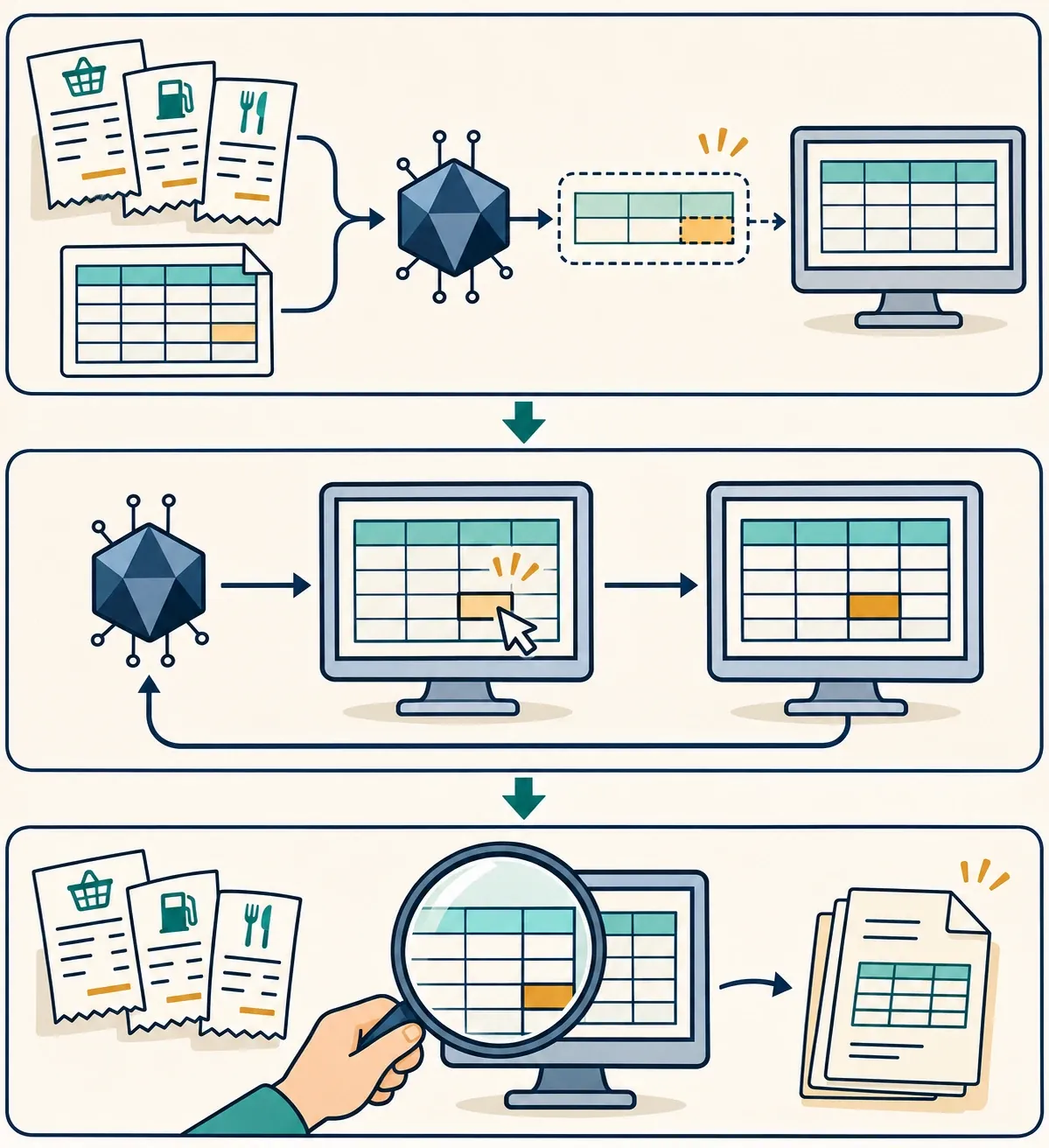
When an expense amount looks wrong, the model chooses whether to reread a receipt or change a cell. A file or screen changes when the connected tool executes an action. The tool returns the changed screen or result, and the model can observe it before choosing the next action. This repeated observation → choice → tool action → observation is a multistep agent workflow. Choosing a model does not itself grant access to files in every app. Supported tools
The fictional sequence below starts with reading material and selecting a proposed edit. In the middle, a tool changes the sheet and returns the result for another look. Finally, a person compares the changed sheet with the original receipts. Approval to submit it externally comes after that review.
The cat asks Q&A
- The researcher
If the cell changed on screen, is the review finished?
Pocket NotebookThe tool action establishes that a change occurred. The responsible person still checks the receipt, formula, and revised amount before approving submission.
3. What token prices actually cover
A token is a small unit used to count material the model processes; it does not correspond one-to-one with characters. Input includes instructions and source material. Output includes generated content and billable internal reasoning tokens, even when those tokens are not visible in the answer. Reviewing a sheet can create several model requests as the system rereads material and checks tool results. The length of the final sentence therefore cannot establish the whole task’s cost. Reasoning and usage
These Standard rates are in US dollars per million tokens, for requests with no more than 272,000 input tokens. Above that input threshold, input and cache rates double and output rates become 1.5 times the short-context rate for the whole request. Processing modes, caching, and tool charges need their own checks. Astra rates · Sol rates
A prompt cache stores earlier processing of an identical beginning of repeated input. The $0.40 and $0.10 rates apply to reused input. Writing input into a cache has a different rate: Astra $10 and Sol $2.50 for 30-minute retention, or Astra $20 and Sol $5 for 12-hour retention, all per million tokens. Each input token uses its applicable ordinary-input, cache-read, or cache-write rate; the write rate is not added on top of ordinary input. A saved app conversation does not guarantee an API cache hit. Cache behavior and billing
| Model | Ordinary input / 1M tokens | Reused cached input / 1M tokens | Output / 1M tokens |
|---|---|---|---|
| GPT‑6.2 Astra | $8.00 | $0.40 | $40.00 |
| GPT‑6.2 Sol | $2.00 | $0.10 | $10.00 |
- Model
GPT‑6.2 Astra
- Ordinary input / 1M tokens
- $8.00
- Reused cached input / 1M tokens
- $0.40
- Output / 1M tokens
- $40.00
- Model
GPT‑6.2 Sol
- Ordinary input / 1M tokens
- $2.00
- Reused cached input / 1M tokens
- $0.10
- Output / 1M tokens
- $10.00
The cat asks Q&A
- The researcher
Does Astra’s 20% reduction mean my project bill will fall by 20%?
Pocket NotebookIt describes the change in ordinary input and output unit rates against the earlier Astra. The bill also depends on request count, token volumes, caching, and tools.
4. A fictional bill with equal token volumes
Assume one API request has 100,000 input tokens, all billed at the ordinary input rate, and 10,000 billable output tokens including reasoning. This calculation covers Standard text-token charges and excludes cache reads and writes, tools, taxes, and credits. It is neither a product test nor a comparison of work quality.
| One request with equal volumes | Input cost | Output cost | Total |
|---|---|---|---|
| Astra | 100,000 ÷ 1,000,000 × $8 = $0.80 | 10,000 ÷ 1,000,000 × $40 = $0.40 | $1.20 |
| Sol | 100,000 ÷ 1,000,000 × $2 = $0.20 | 10,000 ÷ 1,000,000 × $10 = $0.10 | $0.30 |
- One request with equal volumes
Astra
- Input cost
- 100,000 ÷ 1,000,000 × $8 = $0.80
- Output cost
- 10,000 ÷ 1,000,000 × $40 = $0.40
- Total
- $1.20
- One request with equal volumes
Sol
- Input cost
- 100,000 ÷ 1,000,000 × $2 = $0.20
- Output cost
- 10,000 ÷ 1,000,000 × $10 = $0.10
- Total
- $0.30
The cat asks Q&A
- The researcher
At one-quarter of that cost, should I always choose Sol?
Pocket NotebookThis comparison holds token volumes constant. For your expense sheet, also compare missed errors, repeat edits, and the human review needed to accept the result.
To close
What to check in your own work
App users can check the model and limits in their account, then review results using a copy of familiar material. API users should sum the requests and usage needed to finish one task. The release provides two model roles and lower Astra unit rates; accepting a result still depends on checking it against your own sources.
Sources
- OpenAI: launch and app availabilityopenai.com
- GPT‑6.2 Astra: tools and API ratesdevelopers.openai.com
- GPT‑6.2 Sol: tools and API ratesdevelopers.openai.com
- Agent usage: reasoning, tools, and multiple requestsdevelopers.openai.com
- Prompt caching: reads, writes, and retentiondevelopers.openai.com