Daily · Article 01 · 4 min read
- OpenAI
OpenAI makes Decisions API generally available for fast, bounded judgments
Official announcement dated October 22 · rechecked after 06:00 JST October 23
Summary
OpenAI announced general availability of the Decisions API on October 22. Developers can get a predefined choice, probability or score from text, images and JSON. Its speed claim compares the same GPT-6 Luna through the Responses API.
An inquiry needs a small decision: is it about shipping or payment? Routing it doesn't need a long written answer. Decisions API narrows the answer format for this kind of work.
Key facts
OpenAI announced general availability of Decisions API on October 22. GPT-6 Luna is currently the supported model, returning probabilities, choices or scores from text, images and JSON. OpenAI describes it as up to ten times faster than the same Luna through the general-purpose Responses API. It also announced caching, up to 400 questions per request and native GPT-Live voice integration. Announcement

1. Choose the answer's shape first
An API is how an application requests work from another service. Developers supply questions and allowed answers; results return in that form. The application decides what to do with them. JSON is a data format that pairs field names with values, such as an order number.
Imagine a fictional shop's support desk. These examples explain formats, rather than reporting an API run. Answer types
| Type | Example question | Result meaning |
|---|---|---|
| predicate | Is visible damage present in this photo? | Estimated probability between 0 and 1 that the condition is true |
| choice | Shipping, billing or other? | One supplied option |
| score | How severe is damage on a defined scale? | Probability-weighted average of ordered level indices |
A score doesn't automatically carry units such as money lost or accuracy. Define the levels, such as no scratch, minor damage and major damage, before interpreting it. Level indices start at zero, and an average can fall between levels.
The cat asks Q&A
 The researcher
Does 0.9 mean it must be right nine times out of ten?
Pocket NotebookIt's a model estimate of how likely the condition is. Measure actual accuracy against examples with known answers. The consequences of mistakes affect when a person should review it too.
2. Connecting classification to work
For “I was charged twice for this order,” the shop supplies billing, shipping and other. A billing answer can send the inquiry to that team's queue. Refund execution and authorization remain separate parts of the design.
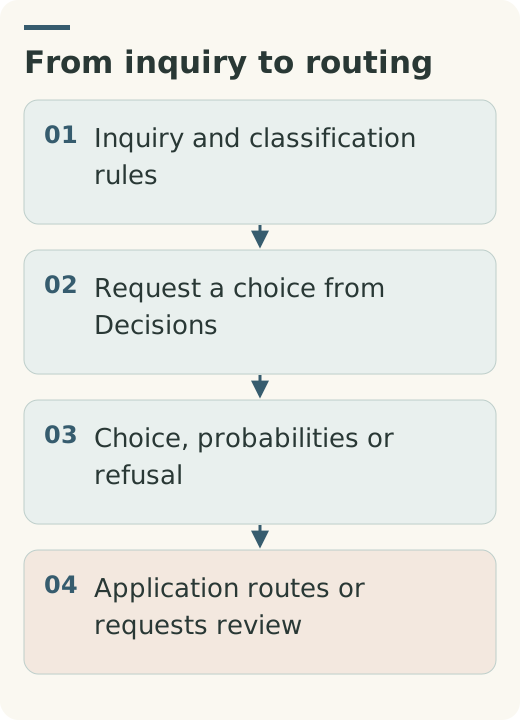
The guide suggests an “other” option for inputs outside the categories and a general review queue. Refusals and ambiguity need handling. Independent questions can share one input, but questions depending on earlier answers need separate requests.
The cat asks Q&A
- The researcher
Could 400 questions finish the whole workflow in one call?
Pocket NotebookThat limit helps bundle independent questions about shared evidence. Checking damage before choosing a repair category creates a dependency, so split those requests. Four hundred limits questions; it doesn't promise completed tasks or correct answers.
3. Reading the speed claim
“Up to ten times” compares an API path, as reported by OpenAI. Real applications include lookups and display processing too. These assumed times illustrate a calculation; they aren't performance measurements.
| Processing time | Original path | Only the decision gets faster |
|---|---|---|
| Order lookup | 800ms | 800ms |
| AI decision | 200ms | 20ms |
| Display | 100ms | 100ms |
| Total | 1,100ms | 920ms |
The decision is ten times faster, but the total falls by (1,100-920) ÷ 1,100 ≈ 16.4%. Measure decision latency, end-to-end latency and classification errors together in a real service.
The cat asks Q&A
- The researcher
So a faster model might not solve the whole delay?
Pocket NotebookIt depends on which stage takes time. Here, the lookup dominates, limiting the overall gain. Measuring actual stages shows what to improve first.
4. Calculating input-based charges
The base price is $0.10 per million input tokens; output tokens aren't charged. Tokens measure text and image input and aren't always equivalent to characters. Regional premiums, long-context multipliers and cache writes have additional conditions. Pricing
Assume 500 total input tokens per request, no caching and no premiums. This is a base-input calculation, not a complete service budget or a usage measurement.
| Calls | Input tokens | Base fee |
|---|---|---|
| 1,000 | 500,000 | 0.5 × $0.10 = $0.05 |
| 10,000 | 5,000,000 | 5 × $0.10 = $0.50 |
Caching reuses identical shared prefixes. A reusable prefix needs at least 1,024 tokens excluding question content, so the 500-token example doesn't automatically qualify. Storage and processing locations also differ: regional processing is supported in the US and Europe, and Zero Data Retention is available to eligible customers. Developer conditions
The cat asks Q&A
- The researcher
How could a small app start?
Pocket NotebookCompare sample inquiries with personal information removed against known categories. Include “other” and review cases, then calculate cost from actual input usage. Follow your organization's rules about what may be sent out.
To close
Handing the work onward
Choosing shipping, billing or other can become a small component inside an app. A mistaken or refused answer must still leave the inquiry somewhere a person can handle it.
Sources
- Announcementopenai.com
- Developer conditionsdevelopers.openai.com
- Pricingdevelopers.openai.com