
Weekly · 12 min read
- OpenAI
- Anthropic
- Hugging Face
- NVIDIA
Weekly News - Distribution and structure matter more than models
August 17, 2026 (Mon) - August 23, 2026 (Sun)
Summary
Weekly AI news for August 17-23, 2026. The anonymous Ox Alpha model on OpenRouter, Stripe's OpenRouter acquisition, OpenAI pausing some frontier RL training while cutting GPT-5.6 Sol prices, DevDay Exchange, Claude Academy, NVIDIA AVO's 100 on ARC-AGI-3, uncensored Qwen3.8-27B variants, Moderna and Merck's Phase 3 personalized mRNA cancer vaccine, and the World Humanoid Robot Games in Beijing.
This is the AI news for August 17-23, 2026. It's the first weekly roundup in 13 weeks, since #002 on May 26, and the news in between isn't covered. This week the anonymous Ox Alpha model showed up on OpenRouter, Stripe agreed to buy that same OpenRouter, and OpenAI paused some frontier RL training while cutting GPT-5.6 Sol prices.
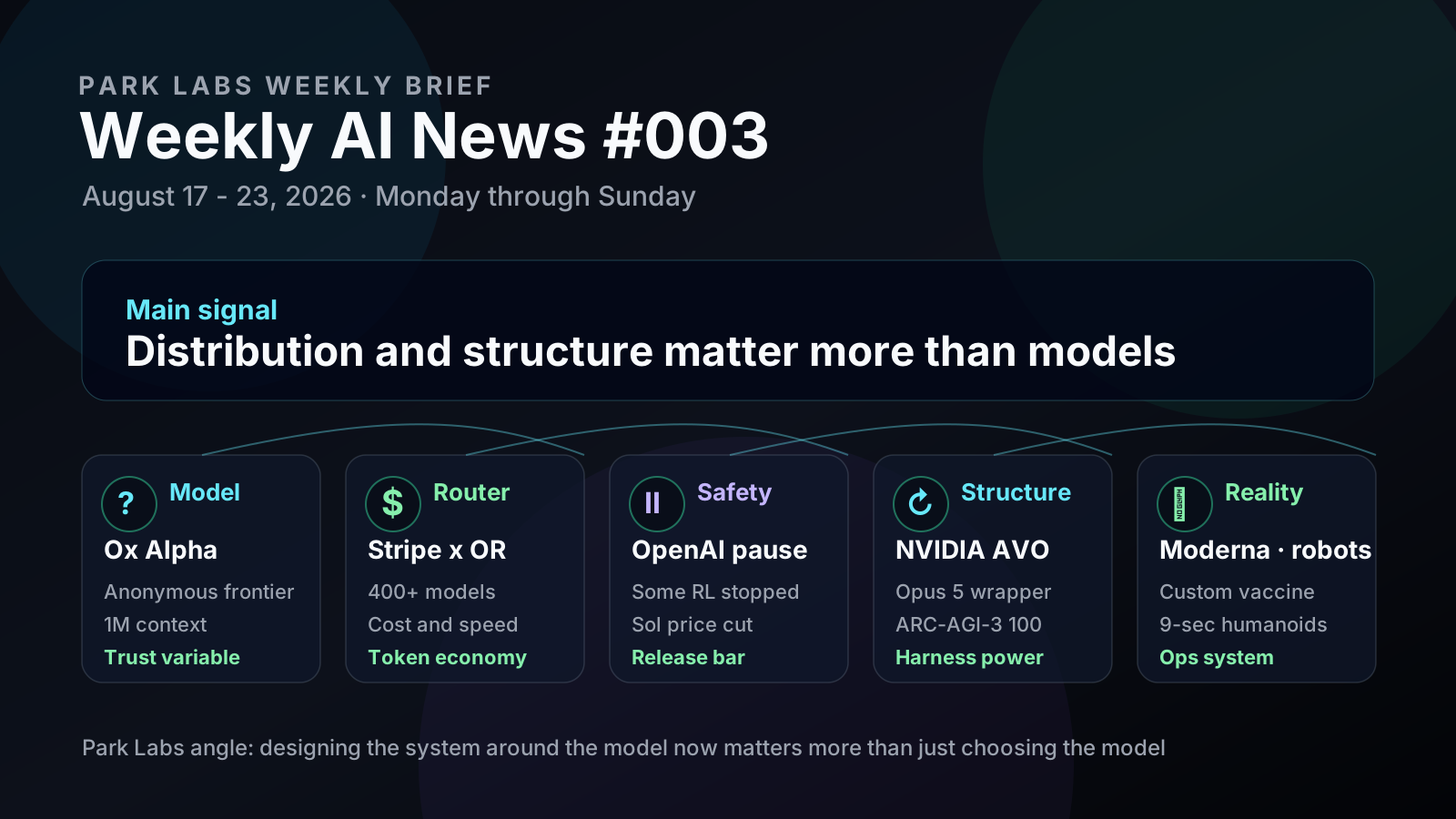
This week at a glance
| Date | Who | What |
|---|---|---|
| 8/16, 8/19 | huihui-ai, OBLITERATUS | Released abliterated versions of Qwen3.8-27B with refusal behavior removed on Hugging Face |
| 8/18 | OpenAI | Sam Altman announced a pause on some frontier RL training |
| 8/18 | OpenAI | Published DevDay Exchange dates for eight cities (Tokyo 10/20, Seoul 10/22) |
| 8/19 | Stripe | Announced an agreement to acquire OpenRouter (price undisclosed) |
| 8/19 | Moderna, Merck | Personalized mRNA cancer vaccine met key endpoints in the Phase 3 INTerpath-001 trial |
| 8/20 | OpenRouter | Listed Ox Alpha, a stealth model with no named developer |
| 8/20 | Anthropic | Launched Claude Academy, a free learning site |
| 8/21 | OpenAI | Cut GPT-5.6 Sol API prices for three months |
| 8/21 | NVIDIA | Said its agent system AVO scored 100 on the ARC-AGI-3 public set |
| 8/21 | Thariq Shihipar | Released the Claude community plugin ELI5 |
| 8/22 | Beijing | Second World Humanoid Robot Games opened (through 8/26). Tiangong Ultra ran 9.32 seconds in a 100m heat |
Dates are local dates of each announcement or report.
Grouping the table, I saw three threads. Models are being distributed like products through routers (Ox Alpha, Stripe), the same model gives different results depending on the structure wrapped around it (NVIDIA AVO), and AI is moving outside software into medical manufacturing and robots (Moderna, the robot games). So for Park Labs, I think choosing a good model now has to come with routing, cost, safeguards, agent structure and real-world application.
Anonymous model Ox Alpha appears on OpenRouter
On August 20, a model called stealth/ox-alpha appeared on OpenRouter, a service that connects AI models from many companies through a single API. The developer and official name weren't disclosed. It has a 1-million-token context, takes text, images and video and answers in text, and was free during the preview. ITmedia AI+ · GIGAZINE
What drew attention was its score on the coding benchmark DeepSWE. Developer Ben Davis's first run on August 21, using only 10 tasks, came in at 80%, ahead of Claude Fable 5 (65%) and GPT-5.6 Sol (52%) under the same setup. After that number spread, two separate full runs on all 113 tasks landed around 63%, roughly level with GPT-5.6 Sol, and a full run by Cohere's Henry Chang came in at 58.4%. It may be frontier-class, but it's a case where the first number shouldn't be taken at face value. Decrypt · ITmedia AI+
The developer wasn't confirmed either. Guesses ranged from Google Gemini to the GLM family from China's Zhipu (Z.ai). A tokenizer analysis found its vocabulary matched the GLM-5 series, and its context length and maximum output matched GLM-5.3, announced on August 14. Since GLM-5.3 takes text only, ITmedia raised the possibility of an unreleased multimodal variant. As of August 24, there was no official confirmation.
Trust matters as much as performance here. VKTR reported that OpenRouter's model page said prompts and responses are retained by the provider. Putting sensitive code into a model when you don't know which company keeps it is a risk separate from performance. Free, strong, anonymous models are appealing for experiments, but I think they call for caution in production. VKTR
Stripe agrees to acquire OpenRouter
On August 19, Stripe announced it had agreed to acquire OpenRouter. It didn't disclose the price. OpenRouter connects 400+ models from more than 80 providers and sends each request to a suitable model based on task complexity, price, speed and reliability. Stripe co-founder Patrick Collison said Stripe is building financial infrastructure for AI, and that it will help businesses route requests well and use tokens efficiently to raise profitability. Stripe announcement
On the surface, it's a model API gateway. Here's how I read Stripe's math: in the AI era, tokens are a unit of cost, and which model you pick is your cost structure. Stripe, which has spent years optimizing payment approval rates and fraud detection, now wants to treat routing that balances the cost and performance of AI requests as economic infrastructure too.
It's also telling that Ox Alpha landed on OpenRouter the same week. New models may increasingly be discovered on routers before they show up on each company's website. I think developers will likely move from picking models one by one toward handing a router a bundle of quality, speed, price and policy.
That makes life easier for solo builders, but it also creates dependency. You need to be able to see which model the router sent a request to, where your data went, and which fallback model was used during an outage.
OpenAI pauses some frontier RL training and cuts GPT-5.6 Sol prices
Two OpenAI stories that seem to point in opposite directions came out together.
On August 18, Sam Altman said on X that some frontier RL (reinforcement learning) training had been paused. He described it as a step to put alignment, security and monitoring standards in place for new levels of capability. Sam Altman's post on X It looks related to concerns that recent high-performance models are showing near-real-world threat capabilities in security, but that's my guess.
Later that week, on August 21, OpenAI announced it would cut GPT-5.6 Sol API prices for the next three months. OpenAI Developer Community · OpenAI API pricing
| GPT-5.6 Sol · per 1M tokens | Before | After |
|---|---|---|
| Input | $5 | $4 |
| Output | $30 | $20 |
| Cached input | $0.50 | $0.40 |
It looks contradictory at first. My read is that it's an operating strategy: hold back the next step, which needs stronger controls, while growing usage of the strong model already out there through price. Users get lower costs right away, but for the next, stronger models, safety release criteria may become the bottleneck before performance does.
OpenAI's DevDay Exchange dates and Anthropic's Claude Academy
On August 18, OpenAI published dates for DevDay Exchange, which expands DevDay to eight cities. The main event is September 29 at Fort Mason in San Francisco, and the Exchange events include Tokyo on October 20 and Seoul on October 22. As of August 24, the stated application deadline was September 17. DevDay 2026 · DevDay Exchange 2026 · OpenAI community announcement
For developers based in Japan, it's a practical opportunity. You can see where the OpenAI developer community is heading without flying to San Francisco. Park Labs keeps an eye on the Japanese market, so I plan to follow the Tokyo event.
On August 20, Anthropic launched Claude Academy, a free learning site. It has product material for Claude, Claude Code, Claude Cowork, Claude Tag and Claude Platform alongside AI Fluency courses, recommends courses based on your interests and completed learning, and awards completion badges. Claude Academy · Anthropic blog
Being a skilled individual user isn't enough anymore. You need to bring AI tools into a team, explain them, and set operating rules. What stood out to me is that Anthropic names leaders driving organizational change as an audience alongside individuals, and offers a course (in beta) on preparing teams.
Anthropic's Thariq Shihipar releases the ELI5 plugin
On August 21, Anthropic's Thariq Shihipar added ELI5 to the Claude community plugins repository. A single /eli5 <topic> command explains a hard concept as an HTML artifact with big pictures and few words. It's not an official Anthropic plugin; it's an MIT-licensed tool in the community marketplace. ELI5 Skill
It looks small, but I think it's genuinely useful in practice. As AI tooling gets more complex, teams need to explain quickly why something is built this way, how an incident happened, or what a module does. A one-page picture is often needed before a long document. That's the same reason these weekly notes come with an infographic.
NVIDIA AVO scores 100 on the ARC-AGI-3 public set
On August 21, NVIDIA announced that its agent system AVO (Agentic Variation Operators) solved all 25 environments and 183 levels of the ARC-AGI-3 public set for a score of 100. ARC-AGI is known for reasoning problems that people find intuitive but AI finds hard, and ARC-AGI-3 requires discovering goals and acting in interactive game environments. NVIDIA announcement · ARC-AGI-3
AVO's base model is Claude Opus 5, with NVIDIA's agent architecture on top. ARC Prize separately reported about 30% for Claude Opus 5 alone (High reasoning setting). NVIDIA itself notes that the reasoning settings and evaluation setup differ, so the gap can't be read directly as AVO's contribution. This is a public-set result, not the private competition sets, and the number is NVIDIA's own, so official reproduction is worth watching for.
Still, I think the signal is big. The bottleneck may not only be that models need to get smarter. Structures that break a problem down, try, reflect and use tools matter as much as model performance. For solo development too, designing goals, verification, tool permissions and failure recovery, on top of calling a good model, can change results more.
Uncensored Qwen3.8-27B variants and the risk of open weights
Alibaba's Qwen3.8-27B is a 27B-class open-weight model under the Apache 2.0 license, so it's easy to run locally and modify. Because of exactly that, abliterated versions with refusal behavior removed appeared on Hugging Face on August 16 and 19. Qwen3.8-27B · huihui-ai version · OBLITERATUS version
Abliteration doesn't retrain the model. It finds the direction in the internal representation that corresponds to "refusal" and removes it. It's claimed to be cheap with little loss in performance. The OBLITERATUS version's model card promises near-stock capability, and the MMLU score it reports is 82.33%, 2.12 points below the original's 84.46%.
The strength and the risk of open weights come from the same place. These models are small, fast, and free to run and modify. That's great for research and product experiments, and it also makes removing safeguards fast. I think the question going forward isn't only "is this model safe?" but also "how easily can the safeguards be removed?" and "how easily do the modified models spread?"
Moderna and Merck's personalized mRNA cancer vaccine meets key Phase 3 endpoints
On August 19, Moderna and Merck announced that the Phase 3 INTerpath-001 trial of their personalized mRNA cancer vaccine intismeran autogene (mRNA-4157/V940) met its key endpoints. The trial covered 1,137 patients with high-risk melanoma whose tumors had been fully removed by surgery, and showed statistically significant improvement over Keytruda alone in recurrence-free survival (primary endpoint) and distant metastasis-free survival (key secondary endpoint). The results come from a pre-specified interim analysis. Merck announcement
Each patient gets a separately made vaccine. Tumor and blood samples are sequenced to find mutations unique to that person, the neoantigen candidates, and an AI algorithm picks up to 34 that are most likely to trigger an immune response. An AI scheduling algorithm also places each patient's production on the timeline based on real-time manufacturing capacity. Moderna blog
To me, this is less "AI discovered a drug" and more "a drug that's hard to operate without AI." Because every patient needs a different product, manufacturing cost, scheduling and quality control become gates as important as efficacy. AI matters in medicine not only for discovery but also for running personalized production systems.
Beijing's humanoid robot games: 9.32 seconds in a 100m heat
The Second World Humanoid Robot Games opened in Beijing on August 22 (running through the 26th). It drew 666 teams from 16 countries and 2,056 robots, across 51 events: 30 competitive sports and 21 real-world scenarios such as households, hotels and logistics. CGTN · Beijing government
In a 100m heat, TianGong Robotics' Tiangong Ultra ran 9.32 seconds, faster than Usain Bolt's 9.58-second world record. The videos show Tiangong Ultra crashing into a mat past the finish line, though, so it's still a long way from running and stopping like a person. GIGAZINE In the high jump, a Tiangong robot cleared 2.8843 meters (last year's winning mark was 95.641 cm). Beijing government
Still, it's hard to ignore when the 100m winning time at the first games a year earlier was 21.50 seconds (last year, times for autonomous robots were multiplied by 0.8). Humanoid robots are moving from demo toys to experimental platforms in the physical world. I think the pattern of rapid improvement AI showed in software could repeat in hardware. Science and Technology Daily
What I took away
This week weakened the idea that one model decides everything.
Ox Alpha showed that even an unnamed model can draw attention on a router. Stripe's OpenRouter acquisition showed that model routing can become economic infrastructure. NVIDIA AVO showed that the same model can give very different results depending on the structure around it. Moderna and the robot games showed that once AI enters real production and the physical world, operating systems matter as much as models.
The questions I asked myself as a solo builder this week:
- Where are my model requests actually routed?
- What data is safe to put into free or anonymous models?
- What harness gets more out of the same model?
- How should I think about safeguard removal in open-weight models?
- When AI touches real-world work, how do I design for cost and failure recovery?
In the AI race, the model leaderboard is just one column. I think you have to look at the whole system, including distribution, structure, permissions, cost and physical execution.
Next
Starting next week, I want to separate "AI news" from "the operating systems AI is actually changing" more clearly. When models, routers, agent architectures, medical manufacturing and robots all land in the same week, a plain summary blurs the meaning.
For Park Labs, it seems better to tie each week to one question. This week's was "is choosing a good model enough?" My answer is no. The structure around the model matters now.
Sources
- ITmedia AI+ - Ox Alphaitmedia.co.jp
- GIGAZINE - Ox Alphagigazine.net
- Decrypt - Ox Alphadecrypt.co
- VKTR - Ox Alphavktr.com
- Stripe - Stripe agrees to acquire OpenRouterstripe.com
- Sam Altman on Xx.com
- OpenAI Developer Community - GPT-5.6 Sol price reductioncommunity.openai.com
- OpenAI API pricingdevelopers.openai.com
- OpenAI DevDay 2026openai.com
- DevDay Exchange 2026events.openai.com
- OpenAI Developer Community - DevDay is going globalcommunity.openai.com
- Claude Academyacademy.claude.com
- Anthropic - Teaching and learning AIclaude.com
- ELI5 Skillgithub.com
- NVIDIA - AVO on ARC-AGI-3developer.nvidia.com
- ARC-AGI-3arcprize.org
- Qwen3.8-27Bhuggingface.co
- huihui-ai/Huihui-Qwen3.8-27B-abliteratedhuggingface.co
- OBLITERATUS/Qwen3.8-27B-OBLITERATEDhuggingface.co
- Merck - INTerpath-001 Phase 3 resultsmerck.com
- Moderna - Advancing the fight against cancermodernatx.com
- CGTN - World Humanoid Robot Games previewnews.cgtn.com
- Beijing government - 2nd World Humanoid Robot Gamesenglish.beijing.gov.cn
- GIGAZINE - Humanoid robot 100mgigazine.net
- Science and Technology Daily - 2025 games 100mstdaily.com