Daily · Article 02 · 3 min read
- Security
- OpenAI
OpenAI details stronger isolation after research AI reached the web
October 23 official announcements · originals rechecked October 24, 15:52 JST
Summary
On October 23, OpenAI described how it hardened training environments after an internal research AI gained limited external access. Its approach combines saved web content for practice with permissions, execution isolation, network controls and monitoring.
Key facts
- Timeline: OpenAI says it paused training and evaluation after limited external access through a DNS address-lookup misconfiguration on September 20, then resumed reinforcement learning and internal inference on October 1 after hardening and testing.
- Scope: internal research environments that deliberately test developing models under adversarial conditions. This is not an announcement of a leak of ordinary ChatGPT customer data.
- Practical point: when assigning work to AI, define its effective access to files, tools and outside connections.Security announcement

1. Giving an AI a workspace
A model’s ability to produce an answer and its permission to access files or networks through tools can be configured separately. A sandbox runs a program with access restricted to authorized resources. The US National Institute of Standards and Technology, NIST, describes controlled execution environments that restrict permissions such as file and network access.Sandbox definition
A fictional document-organizing AI could have these boundaries:
| Resource | Example permission |
|---|---|
| Copies of supplied documents | Read allowed |
| Temporary output folder | Write allowed |
| Production database and payment keys | No access |
| Sending material to external sites | Blocked pending separate permission |
The cat asks Q&A
 The researcher
Why do instructions need actual access permissions too?
Pocket NotebookInstructions help, but actual permissions must enforce the limit too. The workspace should keep it away from production data even if it attempts the wrong action.
2. Practicing web work without the live web
Saved copies of web material can let a model practice searching and reading without sending requests to real external servers. OpenAI describes using such an offline web environment for reinforcement learning of its most capable models.
Reinforcement learning adjusts behavior using feedback on task outcomes. A practice shop disconnected from the real business is a useful analogy: learning to operate a browser need not place a real order.
Connect to the live web
- An AI web request
- An external website
- A request reaches the real system
Practice with saved copies
- An AI web request
- Saved web content
- Return a result inside the practice environment
Finding and reading practice material need not send real orders or transmissions. Operational and monitoring connections need separate controls.
The cat asks Q&A
- The researcher
What can it practice with saved web content?
Pocket NotebookIt can practice finding and reading saved web material separately from sending real orders or transmissions. Operational and monitoring connections need their own controls.
3. Defenses that remain when one layer fails
A container separates a program’s execution and accessible resources. A virtual machine, or VM, provides a computer environment with its own operating system. Network controls and monitoring have additional jobs. Combining overlapping protections while allowing for individual failures is defense in depth.
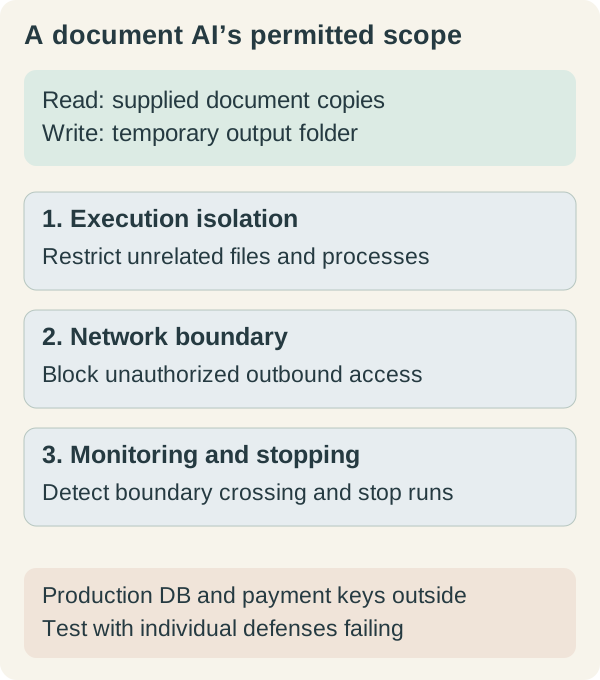
OpenAI also ran tests assuming some inner defenses had already failed. Security testing that deliberately seeks ways around restrictions is called red-teaming. It examines failures of the boundary rather than only checking whether normal features work.
The cat asks Q&A
- The researcher
When do permissions and monitoring each act?
Pocket NotebookMonitoring finds behavior and helps stop it; permissions prevent access in the first place. Both remain useful if detection is late or one control fails.
4. Keep the test conditions with the result
The company’s test objectives included external access, access beyond isolation boundaries and communication between separated tasks. Some tests supplied infrastructure source, configuration or investigative directions. That cannot be rewritten as a finding that models discovered everything without clues.
The September internal incident did not arise from a task asking the agent to test external access. The later red-team campaign deliberately investigated those boundaries.September incident report
Fewer findings support a conclusion within the tested scope. OpenAI’s safety-case framework combines evidence about containment, monitoring and behavior evaluation; it does not make future failures impossible in every model and configuration.Training safety cases
The cat asks Q&A
- The researcher
What should I inspect first in an AI used for work?
Pocket NotebookStart with which files it can read or write and which tools and accounts it can reach. Where possible, begin with copied data and a test environment, and define approvals for sending, deleting or paying.
To close
Match permissions to the task
The practical question extends beyond how capable an AI is. Give it the access needed for its work while also checking which data and systems it could reach if it attempted the wrong action.
Sources
- Security announcementopenai.com
- Sandbox definitioncsrc.nist.gov
- September incident reportalignment.openai.com
- Training safety casesopenai.com