Daily · Article 01 · 4 min read
- OpenAI
Checking business information with ChatGPT, from reference to source
Public demonstration follow-up · originals rechecked October 25
Summary
A practical follow-up to OpenAI Forum’s small-business demonstrations: compare menus and event listings against a reference, retain source evidence and leave final corrections to a person.
Your website says 7 p.m., but the venue's social post says 8 p.m. Both look plausible. Which should an AI accept? Before collecting more information, give the comparison a reliable reference.
Key facts
OpenAI's public Forum recording shows a restaurant operator comparing menu prices and a touring-show operator finding date and time mistakes in event listings. These are their demonstrations, not an independently measured productivity trial. Recording and transcript
This is a practical follow-up rechecked on October 25. The recording's posting date does not establish the event date, and this article is not reporting a new feature launch. The useful task is to identify discrepancies with evidence, rather than delegate the final decision.

1. Give the comparison a reference
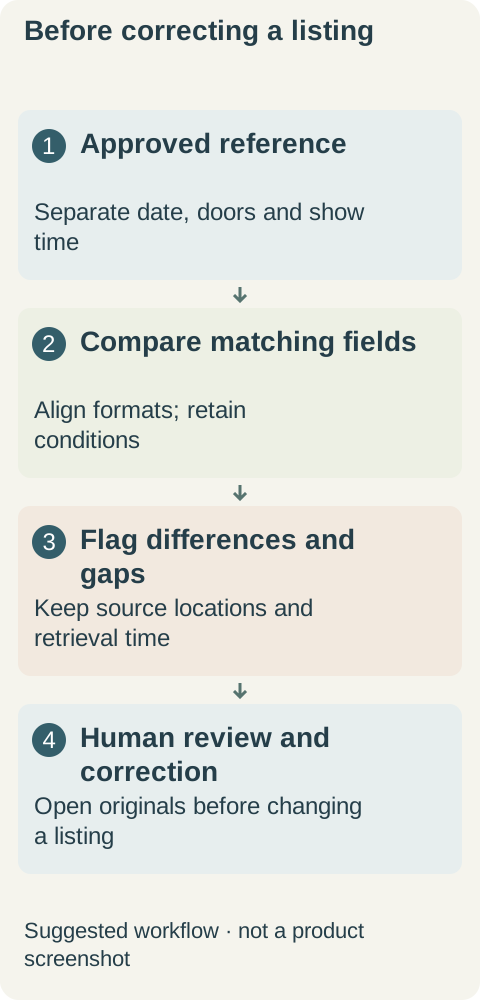
Consider a fictional event. The organizer's approved reference says Saturday, October 31; doors at 6 p.m.; show at 7 p.m. A poster saying 6 p.m. is not necessarily wrong: it might refer to the doors, not the performance.
A reference sheet is the material you agree to compare against. Give the date, venue, meaning of each time and last verification date separate fields. The organizer must first confirm it is current; a stale reference can produce a tidy but misleading comparison.
The cat asks Q&A
 The researcher
What if three other listings all say 8 p.m.?
Pocket NotebookCheck the latest approved record instead of taking a vote. Ask the AI to report disagreement with the reference; deciding which record is correct is a separate step.
2. Put equivalent information in matching fields
“7 PM,” “19:00” and “seven in the evening” express the same time. “Doors open” and “show starts” describe different fields, even when their numbers happen to match. Here, normalization means putting equivalent information into a form you can compare.
This fictional table is an explanatory example, not an actual AI result. The reference show time is 19:00, and the comparison assumes the original wording was read.
| Material | Field and value | Comparison with reference |
|---|---|---|
| Venue poster | Show starts: 8 PM | 20:00; possible start-time discrepancy |
| Local event directory | Doors open: 18:00 | Matches the door time |
| Another social post | 19:00, no field specified | Unclear whether doors or show |
“Unresolved” is useful information. Leave a record when a source is old or inaccessible instead of filling the gap with a guess. Search availability also depends on account and environment settings, so request the original source actually read and its retrieval time. Official search guidance
The cat asks Q&A
- The researcher
Does a citation mean the check is finished?
Pocket NotebookOpen it to see whether it supports the specific statement. A search snippet, the page retrieved now and an approved organizer record are different forms of evidence.
3. Compare the conditions beside a price
Imagine two fictional restaurants selling the same type of dish. Both prices include tax and apply to dining in. A offers 200g for ¥600; B offers 300g for ¥720. B has the higher displayed price, but matching the portion sizes changes the comparison.
| Fictional menu | Price and portion | Price per 100g |
|---|---|---|
| A | ¥600 · 200g | 600 ÷ 200 × 100 = ¥300 |
| B | ¥720 · 300g | 720 ÷ 300 × 100 = ¥240 |
This only illustrates equal-portion arithmetic. It does not establish equal ingredients, quality or costs, or show that another business should cut its price. For delivery comparisons, record separately whether delivery charges and fees are included.
The cat asks Q&A
- The researcher
Should I change my menu to the AI's recommended price?
Pocket NotebookCalculation and pricing are separate decisions. Check the portions, tax and selling conditions it compared, then use your actual costs and operating policy to set prices.
4. Separate one comparison from recurring execution
A small starting task is to choose a reference with no personal data and two public listings, then ask for matching fields, source locations, differences and unresolved items in a table. Complete one cycle through human review and correction. This is a suggested workflow, not a report that this article connected services or ran an automation.
For recurring checks, confirm search access, required files and permissions, time zone and result destination. Desktop tasks using local files require the computer to be on and the app running; web tasks cannot directly read a folder on your computer. Availability also depends on plan and workspace settings. Official scheduled-task guidance
The cat asks Q&A
- The researcher
Where should I look if a scheduled report never arrives?
Pocket NotebookCheck whether the task was scheduled, whether it ran and whether it produced a result, in that order. A run record can still contain a failed source lookup or work awaiting review.
To close
Make the correction clear enough to review
“Run my business better” leaves the comparison undefined. A current reference and a bounded set of sources produce specific differences to inspect. Keep the meaning of each time and the conditions of each price visible, so a person can open the source and make the correction.
Sources
- Recording and transcriptforum.openai.com
- Official search guidancelearn.chatgpt.com
- Official scheduled-task guidancelearn.chatgpt.com