Daily · Article 01 · 5 min read
- Security
Puppet flaw enters the exploited catalog. Verify the restart too
3 November fixes · 17 November CISA catalog addition
Summary
An authenticated report can reach an unsafe processing path. Check the fixed branch, restart, and version actually running on each server.
Key facts
Puppet, software used to manage the settings of many computers, has a report-processing flaw identified as CVE-2026-115731. Its supplier, Perforce, lists 3 November as the resolution date for fixed releases. The US Cybersecurity and Infrastructure Security Agency, CISA, added the flaw to its known-exploited catalog on 17 November. The new development is evidence of exploitation of an already disclosed flaw. This is not a newly released patch. Supplier advisory · CISA catalog
Organizations using Puppet should verify an update, a Puppet Server restart, and the version actually running. Ordinary website visitors are not being asked to install anything. We have not checked whether any individual server is compromised.

1. What the managed computer sends
Puppet helps a central server manage settings across computers. A small program installed on a managed computer, called an agent, sends a report of the settings work back to Puppet Server. Here, agent means a computer-management client, not an AI agent.
The server reconstructs the transmitted report into data it can read. That process is called deserialization. In normal operation, information such as “the settings task finished” should become a record. According to the supplier, affected versions can interpret a specially crafted data type in a report in a way that leads to code execution. The code runs as the Puppet service user. The advisory does not say that every such execution automatically receives full administrator, or root, privileges. Supplier explanation
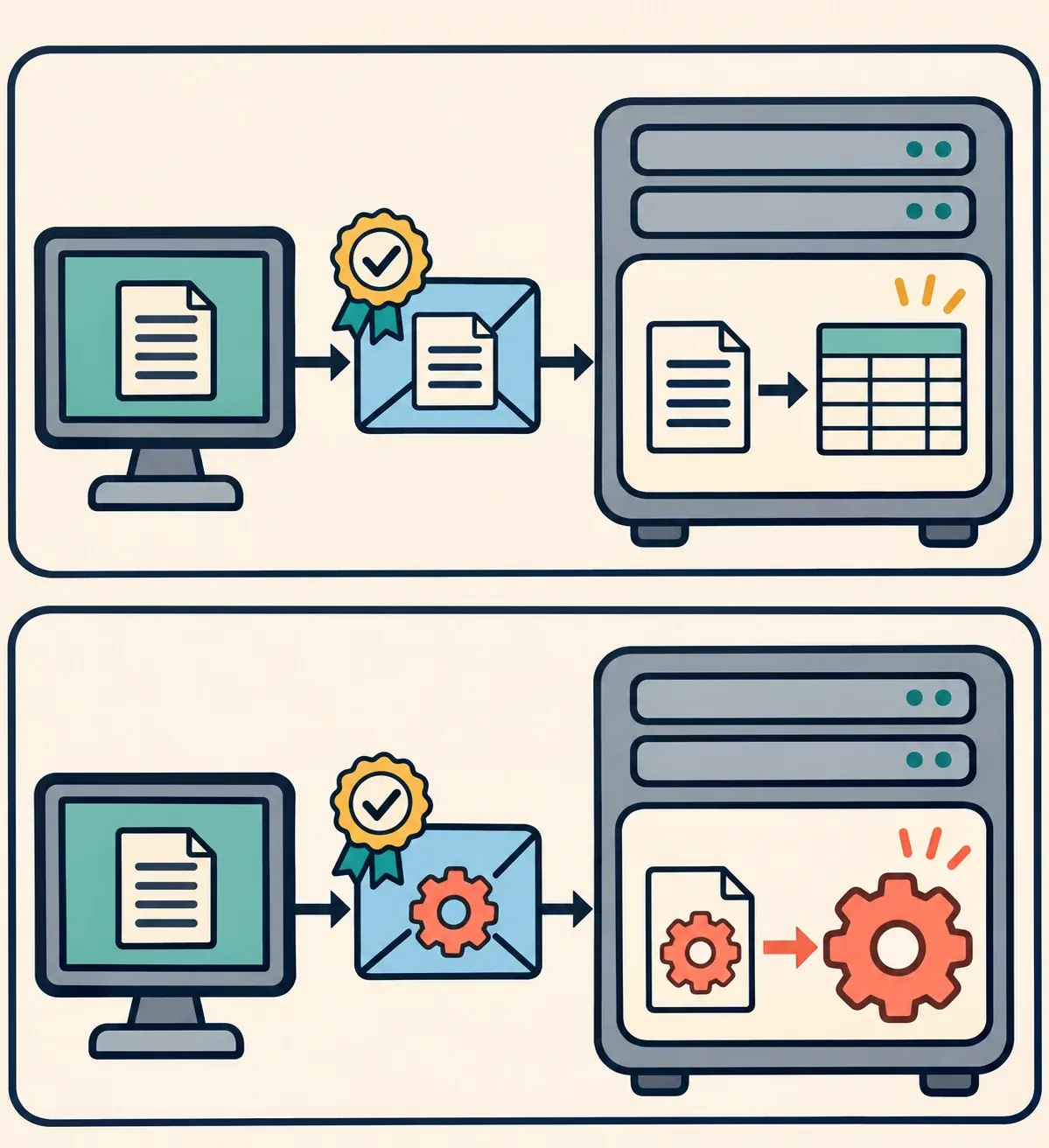
The upper scene below shows a report being read as data. The lower scene shows crafted data leading to an action on the server. Both envelopes have an identity badge: checking the sender’s identity does not make an unsafe content parser safe.
The cat asks Q&A
 The researcher
If the sending computer is authenticated, why must the server still check its report?
Pocket NotebookA certificate helps establish who connected. Safely interpreting what they sent is a separate responsibility, so data from an authenticated client still needs safe processing.
2. Which connection conditions matter
The advisory describes a client holding any agent certificate signed by the certificate authority, or CA. The CA signs certificates that establish a managed computer’s connection credentials. Describing this simply as “any internet visitor can run code” would remove an important condition.
A weak certificate-issuing process can broaden exposure. The supplier says an initially unauthenticated network attacker can obtain a valid certificate where the CA automatically signs requests without strong verification. Operators need to inspect their own signing policy and verification process. Advisory conditions
| Situation to check | Meaning in the advisory | Evidence for the operator |
|---|---|---|
| Client already holds a valid agent certificate | Can reach the affected report-processing path | Certificate issuance and revocation records; server version |
| CA automatically signs without strong verification | An initially unauthenticated attacker may obtain a certificate | Automatic-signing policy and checks on certificate requests |
- Situation to check
Client already holds a valid agent certificate
- Meaning in the advisory
- Can reach the affected report-processing path
- Evidence for the operator
- Certificate issuance and revocation records; server version
- Situation to check
CA automatically signs without strong verification
- Meaning in the advisory
- An initially unauthenticated attacker may obtain a certificate
- Evidence for the operator
- Automatic-signing policy and checks on certificate requests
The cat asks Q&A
- The researcher
Can I postpone the update if automatic signing is disabled?
Pocket NotebookThe flaw remains in the path used by clients with valid certificates. Check certificate policy alongside the affected version and apply the fix.
3. From a published fix to a running fix
These are the supplier’s affected ranges and fixed releases. Use the row for the product branch you run rather than comparing numbers across different branches. Puppet Core supplies underlying components bundled in the Enterprise product. Version list
| Product branch | Affected range | Fixed release |
|---|---|---|
| Puppet Enterprise 2026 | From 2026.0.0, before 2026.0.1 | 2026.0.1 |
| Puppet Enterprise 2025 | From 2025.0.0, before 2025.12.1 | 2025.12.1 |
| Puppet Enterprise 2023.8 | From 2023.8.0, before 2023.8.13 | 2023.8.13 |
| Puppet Core 9 | From 9.0.0, before 9.1.3 | 9.1.3 |
| Puppet Core 8 | 8.x before 8.22.2 | 8.22.2 |
- Product branch
Puppet Enterprise 2026
- Affected range
- From 2026.0.0, before 2026.0.1
- Fixed release
- 2026.0.1
- Product branch
Puppet Enterprise 2025
- Affected range
- From 2025.0.0, before 2025.12.1
- Fixed release
- 2025.12.1
- Product branch
Puppet Enterprise 2023.8
- Affected range
- From 2023.8.0, before 2023.8.13
- Fixed release
- 2023.8.13
- Product branch
Puppet Core 9
- Affected range
- From 9.0.0, before 9.1.3
- Fixed release
- 9.1.3
- Product branch
Puppet Core 8
- Affected range
- 8.x before 8.22.2
- Fixed release
- 8.22.2
The cat asks Q&A
- The researcher
Does an installation record prove the fix is active?
Pocket NotebookThe supplier’s CVE record says to restart Puppet Server after upgrading so it loads the fixed code. Request the restart time and running version alongside the installation record. Remediation instructions
4. Evidence from the operator
A published fix still needs to reach the computers processing live requests. In a multi-server installation, evidence for one server does not establish that all servers were updated.
| Stage and responsible party | Currently established | Evidence of completion |
|---|---|---|
| Fix preparation · supplier | Confirmed: fixed versions and remediation published | Supplier advisory and CVE instructions |
| Update availability · supplier | Confirmed: resolved releases dated 3 November | Obtain the fixed release for the relevant product branch |
| Application on running servers · operator | Unverified for each individual target | Running version, update record, restart/application time, and normal report reception |
- Stage and responsible party
Fix preparation · supplier
- Currently established
- Confirmed: fixed versions and remediation published
- Evidence of completion
- Supplier advisory and CVE instructions
- Stage and responsible party
Update availability · supplier
- Currently established
- Confirmed: resolved releases dated 3 November
- Evidence of completion
- Obtain the fixed release for the relevant product branch
- Stage and responsible party
Application on running servers · operator
- Currently established
- Unverified for each individual target
- Evidence of completion
- Running version, update record, restart/application time, and normal report reception
The cat asks Q&A
- The researcher
What should I ask a hosting provider that says “the patch is available”?
Pocket NotebookAsk for the version your Puppet Server actually runs and when it was restarted. For several servers, request results for each target and confirmation that normal reports are arriving.
5. What confirmed exploitation establishes
CISA’s Known Exploited Vulnerabilities catalog, or KEV, means evidence of exploitation has been established. It does not identify whether your own server was compromised. The entry’s ransomware-use field is Unknown; that must not be read as “none.” Original CISA feed
If you operate a site but do not know whether its infrastructure uses Puppet, ask the server-management team first. If it does, request both update evidence and an investigation for signs of compromise. Updating repairs the vulnerable path; establishing that no earlier intrusion occurred requires separate evidence.
The cat asks Q&A
- The researcher
If the site still opens normally, does that show it was not exploited?
Pocket NotebookA normal response cannot establish that. Ask the operator for findings from certificate issuance records, report-processing records, and server activity.
To close
Evidence to obtain next
The catalog addition makes it more urgent to establish that the existing fix reached live servers. Knowing whether Puppet is used, the running version for its branch, and the restart/application time turns an advisory into an operational response.
Sources
- Perforce: affected versions and fixesportal.perforce.com
- CISA: original known-exploited catalog feedcisa.gov
- Original CVE record: upgrade and restart instructionscveawg.mitre.org