

Weekly AI News #003 - Distribution and structure matter more than models
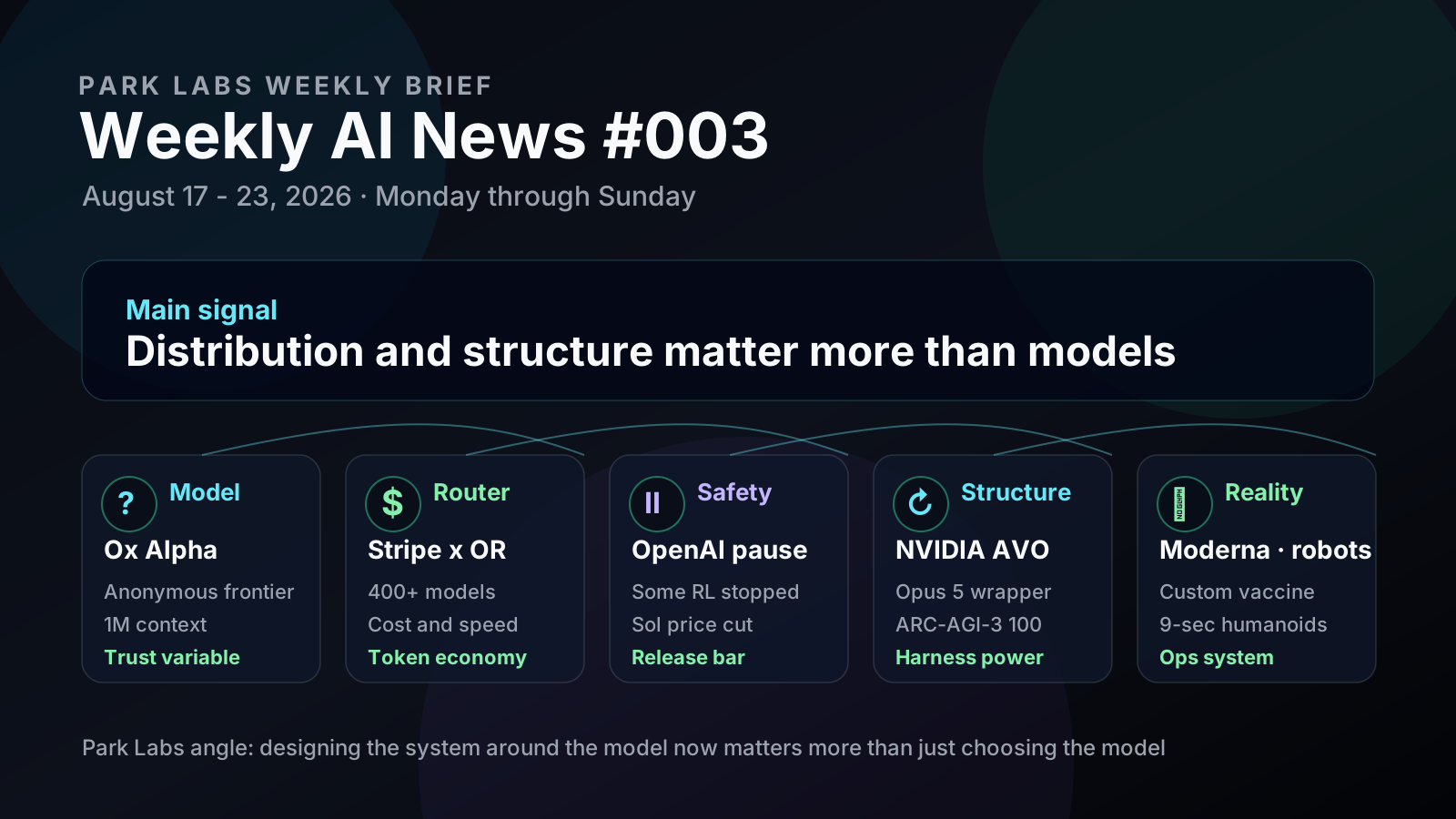
The third weekly AI news roundup. This week brought the mysterious Ox Alpha model, Stripe's OpenRouter acquisition, OpenAI's safety pause and price cut, Claude Academy, NVIDIA AVO, personalized mRNA cancer vaccines, and humanoid robot races. The common thread: the wrapper, router, and real-world operating system around models are becoming as important as the models themselves.
This is the third weekly AI news roundup. Looking back at Monday, August 17 through Sunday, August 23, 2026, the important pattern was not only model performance. It was how models are distributed, wrapped, routed, governed, and connected to the physical world.
🔬 The bigger pattern this week
The topics were broad: an anonymous frontier-class model, an AI model gateway acquisition, a frontier RL training pause, AI learning platforms, agent architecture, open-weight safety removal, a personalized cancer vaccine, and humanoid robot competitions.
The common thread was clearer than the topic list looks.
Models are becoming routed commodities
Ox Alpha appeared on OpenRouter without naming the developer, and Stripe agreed to acquire OpenRouter. The question may shift from "which model should I call" to "which routing layer chooses the right model for each task."
Architecture changes outcomes
NVIDIA AVO did not introduce a new base model. It wrapped Claude Opus 5 in an agent architecture and reported 100 on ARC-AGI-3's public set.
AI is moving beyond software
Moderna's personalized mRNA cancer vaccine and the humanoid robot games show AI entering medical manufacturing, robotics, and physical execution.
For Park Labs, choosing a strong model is no longer enough. Routing, cost, safety, agent structure, and operational boundaries matter just as much.
🐂 Ox Alpha: a mystery frontier-class model
On August 20, OpenRouter listed stealth/ox-alpha. The developer was not named. OpenRouter says it is not the developer, owner, or provider; a third-party provider is operating the model anonymously during preview. The model has a 1M-token context window, accepts text, image, and video inputs, and is free during preview.
It drew attention because early benchmark numbers spread quickly. A coding benchmark result of 80% on DeepSWE circulated, putting it above other frontier models. That number was later corrected by the evaluator to about 63% after the full run. So the useful framing is: promising, possibly frontier-class, but not something to treat as settled based on the first number.
The provider is still unconfirmed. Some people guessed Google Gemini Pro. Others pointed to Chinese GLM/Zhipu signals, including tokenizer fingerprints. No company has confirmed it.
The security angle matters more than the leaderboard. OpenRouter states prompts and completions are retained by the third-party provider. If the provider is unknown, you do not know who is retaining sensitive prompts. Free, strong, anonymous models are useful for experiments; they are not an automatic fit for production code or confidential data.
💳 Why Stripe buying OpenRouter matters
Stripe announced on August 19 that it agreed to acquire OpenRouter. OpenRouter routes requests across 400+ models from more than 80 providers, optimizing by task complexity, price, speed, and reliability.
On the surface, this is an API gateway. Strategically, it is closer to economic infrastructure for AI. Tokens are becoming a cost unit, and model choice is part of gross margin. Stripe has spent years optimizing payments, authorization, and fraud; now it is moving toward token routing and AI profitability.
Ox Alpha appearing on OpenRouter in the same week is a good signal of the future. New models may be discovered first through routers, not through individual vendor dashboards. Developers may increasingly delegate model selection to a neutral layer that balances quality, speed, price, and policy.
That helps solo builders, but it also creates dependency. You need observability: which model handled the request, where data went, what fallback was used, and why the router made that decision.
🛑 OpenAI: safety brakes and cheaper Sol
Two OpenAI stories pointed in opposite directions.
First, Sam Altman said some frontier RL training was paused to meet alignment, security, and monitoring standards for new levels of capability. Given recent concern about frontier models in cyber and autonomous settings, this looks like a brake on pushing the next capability step before the monitoring layer is ready.
Second, GPT-5.6 Sol received a three-month promotional price cut. Input fell from $5 to $4 per million tokens, output from $30 to $20, and cached input from $0.5 to $0.4.
That combination looks contradictory at first: slow down new training, discount the strongest deployed model. Operationally, it makes sense. Be more cautious with the next capability jump, while increasing adoption of the current top model through price.
For users, the immediate news is lower cost. The longer-term signal is that safety release criteria may become the bottleneck for the next frontier step.
📅 DevDay 2026 and Claude Academy
OpenAI published the DevDay 2026 schedule. The main event is September 29 at Fort Mason in San Francisco. This year, OpenAI is also running DevDay Exchange in eight cities. Tokyo is on October 20, Seoul is on October 22, and the Tokyo application deadline is September 17.
For developers based in Japan, this is practical. You do not need to fly to San Francisco to see the direction of the OpenAI developer ecosystem. Given Park Labs' Japan-facing projects, the Tokyo event is worth tracking.
Anthropic also launched Claude Academy for free. It includes learning paths for Claude.ai, Claude Code, Claude Cowork, Claude Tag, Claude Platform, and broader AI literacy material. It can be viewed without login; Claude accounts can save progress and earn badges.
The important point is not only education for individuals. Teams need a way to teach AI usage, explain operating rules, and onboard non-experts. Treating managers as a separate audience is the right move.
🧒 ELI5 and explainable internal tools
Anthropic's Thariq Shihipar highlighted a community plugin called ELI5. With a single /eli5 <topic> command, it creates a visual HTML artifact that explains a difficult topic with large diagrams and minimal text. It is not an official Anthropic plugin; it is a community marketplace tool under an MIT license.
This matters because AI workflows are getting complex. Teams need fast explanations of modules, incidents, architecture choices, and tradeoffs. A one-page visual explanation often comes before a long document.
That is also why these weekly news notes now use infographics. A reader should see the map before reading the details.
🧠 NVIDIA AVO: the wrapper matters
NVIDIA announced that AVO, its agent system, scored 100 on the public ARC-AGI-3 set. ARC-AGI is designed around problems that humans can often solve intuitively but AI systems struggle with. ARC-AGI-3 adds an interactive game-like setting where the system needs to discover objectives and act efficiently.
The core detail: AVO is not a new base model. It wraps Claude Opus 5 in NVIDIA's agent architecture. NVIDIA says the same Opus 5 scored 30 alone and 100 inside AVO. This is self-reported and public-set-based, so official reproducibility still matters.
Even with that caveat, the signal is important. The bottleneck may not always be model intelligence. Decomposition, retries, tool use, feedback loops, and state management can change the system's effective capability.
For solo builders, the implication is direct: calling a better model is only one lever. Building a better harness may matter more.
🔓 Qwen3.8-27B and open-weight safety risk
Alibaba's Qwen3.8-27B is a 27B-class open-weight model with an Apache 2.0 license. It can run locally and be modified freely. This week, multiple abliterated or uncensored variants appeared on Hugging Face.
Abliteration removes refusal behavior by identifying and projecting out internal refusal directions rather than retraining the model from scratch. The cost is low, and model cards claim near-stock capability with reduced refusals.
The issue is that the strength and risk come from the same property. The model is practical, local, open, and modifiable. That is good for research and product experiments. It also means safety behavior can be removed and redistributed quickly.
The future question is not only "is this model safe?" It is also "how easy is it to remove the safety behavior, and how quickly do modified versions spread?"
🧬 Moderna and personalized mRNA cancer vaccines
Moderna and Merck reported that their personalized mRNA cancer vaccine, intismeran autogene (mRNA-4157/V940), met key Phase 3 endpoints in high-risk melanoma. The trial tested recurrence prevention after surgery and reported significant improvement over Keytruda alone in recurrence-free survival and distant metastasis-free survival.
The manufacturing workflow is the interesting part. Each patient's tumor is sequenced, neoantigen candidates are identified, and up to 34 are selected for an individualized mRNA vaccine. The process takes roughly six weeks from tumor sampling to finished vaccine. Scheduling is also handled by an AI system.
This is less "AI found a drug" and more "this drug needs AI to be commercially operable." Every patient effectively gets a custom product, so manufacturing cost, scheduling, quality control, and logistics become the real bottleneck.
🏃 Humanoid robot games and physical speed
Beijing hosted the World Humanoid Robot Games, with 666 teams from 16 countries and 2,056 robots. The event expanded to 51 categories, including athletic events and practical scenarios such as industrial assembly, hotel service, and disaster response.
The headline was speed. Tiangong Ultra reportedly ran 100 meters in the 9-second range, faster than Usain Bolt's 9.58-second human world record. High jump results also exceeded human records. The caveat is obvious from the videos: these robots do not yet run and stop like humans. Some cross the finish and crash into padding.
Still, the pace of improvement matters. If records moved from the 20-second range to the 9-second range in a year, humanoid robotics is becoming a serious physical-world testbed. Hardware progress, especially from China, needs to be watched.
💡 What I took away
This week weakened the idea that the model alone decides everything.
Ox Alpha showed that anonymous models can gain attention through a routing platform. Stripe's OpenRouter acquisition showed that routing itself can become economic infrastructure. NVIDIA AVO showed that the wrapper can change results dramatically. Moderna and the robot games showed that once AI enters manufacturing and physical action, operations become as important as intelligence.
For a solo builder, the questions are practical:
The AI competition is no longer just a leaderboard. It is a system-level competition across distribution, architecture, permissions, cost, and physical execution.
🔗 Sources
This note is based on the official announcements, reporting, model cards, and community materials below. Benchmark and community claims are treated as pre-official unless independently verified.
🎯 Next
Next week I want to separate "AI news" from "AI operating systems" more clearly. When a week includes models, routers, agent architectures, medical manufacturing, and robots, a flat summary loses the point.
For Park Labs, each weekly note should be organized around one question. This week's question was: is choosing a good model enough? My answer is no. The system around the model matters now.