

Weekly AI News #001 - AI is moving from answers to execution
The first weekly AI news roundup. Ten AI stories from this week point in the same direction: AI is moving beyond smarter chatbots and into development environments, laptops, search, finance, and daily business workflows.
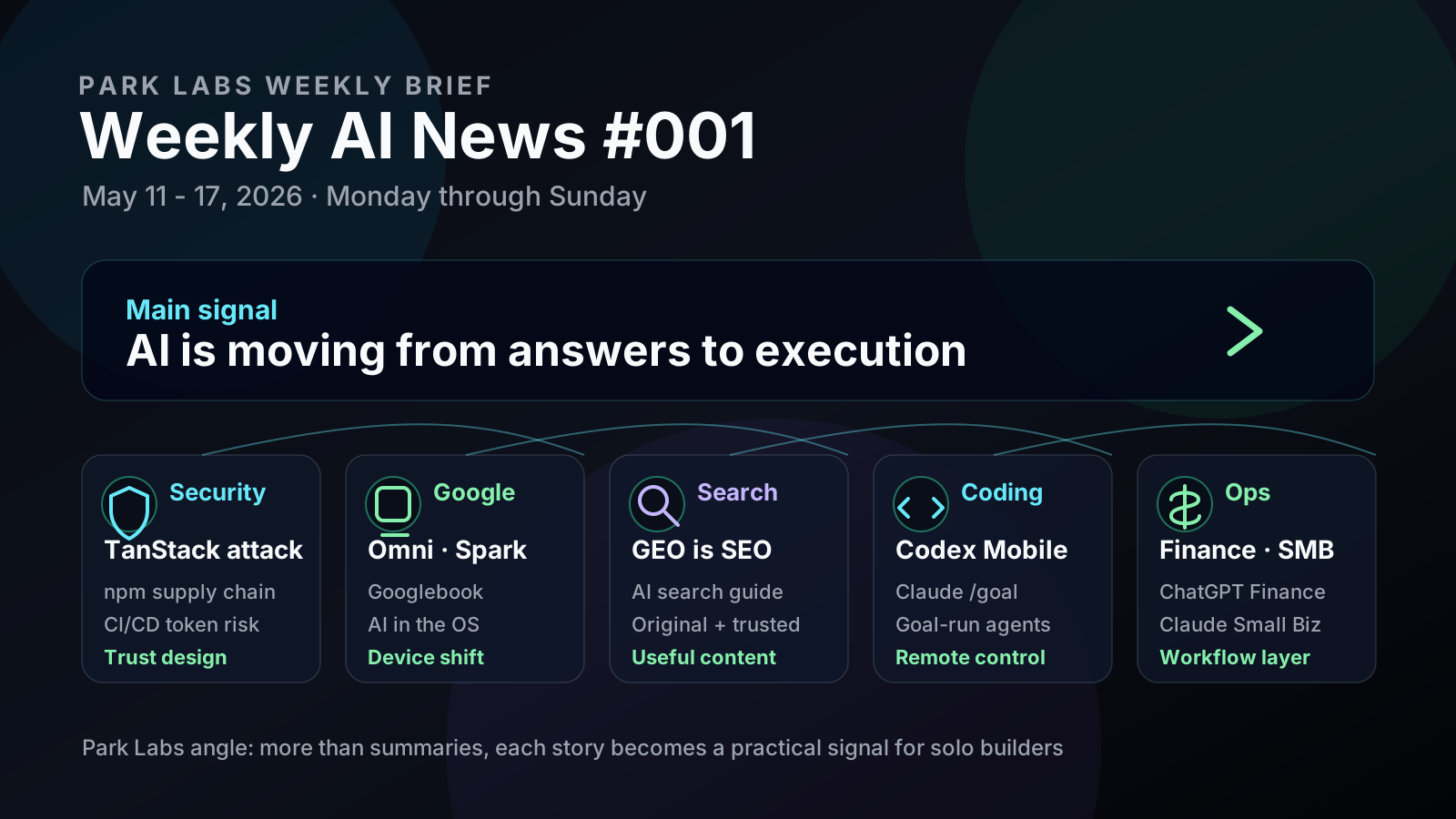
This is the first weekly AI news roundup. I pulled together ten AI stories I paid attention to from Monday, May 11 through Sunday, May 17, 2026, and the larger pattern is clear: AI is moving from something that answers questions to something that actually runs inside workflows.
🔬 The bigger pattern this week
This week's news fell into three buckets.
AI is entering the work surface
Codex Mobile, Claude Code /goal, and Claude for Small Business all point to AI moving beyond the chat window and into actual work loops.
AI is becoming part of the device and OS layer
Googlebook is not just a laptop with AI features. It looks like Google's attempt to rethink the laptop around Gemini Intelligence.
Security and trust matter more than ever
the TanStack supply chain attack showed how important open source packages, CI/CD, and developer credentials have become as attack surfaces.
Model performance is still important, of course. But this week felt less about which model is smartest and more about where AI connects, what it can do, and how much we can trust it to act.
🛠️ Developer tools are getting easier and riskier
The heaviest story was the TanStack npm supply chain attack. A widely used package ecosystem was compromised, and OpenAI later disclosed that two employee devices were affected. OpenAI said it found no evidence that user data or production systems were compromised, but limited credential material was exfiltrated and the company is rotating code-signing certificates.
What makes this scary is that the target was not just one company's server. The attack touched the daily surface developers rely on: packages, GitHub Actions, cache behavior, and release pipelines.
Dependency hygiene
new versions and new packages need more delay, scanning, and verification before they are trusted.
Smaller token scopes
CI/CD credentials need to be narrowed continuously.
Agent permission design
as AI coding agents become more capable, the files and tokens they can reach become part of the security boundary.
At the same time, Codex Mobile and Claude Code /goal both showed how convenient agentic development is becoming. Codex can now be monitored and steered from a phone, while Claude Code can keep working toward a completion condition.
That is genuinely useful. But the more agents run for long periods and touch real environments, the more developer security becomes a product feature, not just an internal checklist.
💎 Google is pushing AI into the OS layer
Google had a busy week: Googlebook, Gemini Omni leaks, Gemini Spark leaks, and an official guide for AI search optimization.
Googlebook stood out the most. If Chromebook was a web-first laptop, Googlebook feels like an AI-first laptop built around Gemini Intelligence. Magic Pointer brings contextual suggestions to the cursor. Create your Widget lets users build custom widgets with natural language. Android phone files and apps are meant to flow directly into the laptop experience.
Gemini Omni is still leak-based, so I am treating it carefully. But the direction is important. The interesting part is not only video generation. It is the idea of editing video through conversation: "change this scene," "lower this sound," "regenerate only this part."
Gemini Spark is also based on pre-I/O reporting, but it points toward a more proactive agent. Instead of waiting for prompts, it may use app context, schedules, logged-in web sessions, and user signals to notice what needs to happen.
Google's advantage is not just model quality. It owns Search, Android, Chrome, Workspace, YouTube, Gmail, and Calendar. If AI becomes a quiet layer across those surfaces, users may not need to open a separate AI app at all.
📊 In AI search, good content still matters
Google's new guide for generative AI search optimization was also worth reading. SEO people have been talking about GEO and AEO, but Google's message was simple: from Google's perspective, optimizing for generative AI search is still SEO.
No special AI-only markup. No magic structure. No shortcut that replaces useful content.
The important parts are still original perspective, reliability, experience, and content that actually helps people.
That connects directly to Park Labs. A plain AI news summary will be easy to replace. What makes it worth reading is the angle: why I care about a story, what it means for solo product building, and how it changes the way I operate these experiments.
That is why I wanted this weekly note to have one clear thread: AI is becoming an execution layer.
💰 AI is entering personal and small-business operations
Anthropic's Claude for Small Business and OpenAI's personal finance experience in ChatGPT both point in the same direction. AI is moving into money and operations.
Claude for Small Business connects with tools like QuickBooks, PayPal, HubSpot, Canva, Docusign, Google Workspace, and Microsoft 365. It includes workflows for payroll planning, month-end close, campaign operations, invoice chasing, contract review, and more.
ChatGPT's personal finance preview is starting with U.S. Pro users. Through Plaid, users can connect bank, card, and investment accounts, then ask questions about spending, subscriptions, portfolio performance, and planning.
Both are still very U.S.-centered. To work well in Korea or Japan, they would need local accounting tools, payment providers, tax workflows, and banking integrations.
Still, the direction is obvious.
Small businesses
AI helps with repetitive but important work across accounting, marketing, contracts, and customer operations.
Individuals
AI helps make sense of spending, subscriptions, investments, and budgeting.
For Park Labs, this matters twice. I need these AI operating layers as a solo builder, and these shifts also reveal new B2C product opportunities.
🔄 Pricing and usage limits keep moving
Anthropic's pricing update was another important signal. Programmatic use through Agent SDK, claude -p, Claude Code GitHub Actions, and related workflows will move into a separate monthly credit system. Pro gets $20 in credits, Max 5x gets $100, and usage beyond that follows API-style pricing.
As a user, this is a little tiring. AI tool pricing and usage limits have been changing a lot, and it makes cost planning harder for solo builders.
But it also makes sense. Once agents run for minutes or hours, reading code, executing commands, and running tests, the cost structure is very different from a short chat.
Going forward, the question is not only "which model is best?" It is also "can I predict what this workflow will cost?"
💡 What I took away
The thing I felt most this week is that AI is being absorbed into products faster than I expected.
At first, the center of gravity was chatbots. Then coding tools like Claude Code and Codex became serious. Now AI is showing up in laptops, mobile control surfaces, finance dashboards, small-business workflows, and search results.
The next set of questions feels more practical than flashy.
The next layer of AI competition will not be only intelligence. It will be trust design.
🔗 Sources
This note is based on the official announcements and reporting below. Leak-based items are treated as unconfirmed in the article.
🎯 Next
For now, I am going to publish this first weekly AI news note and see how it feels.
Next time, I may keep the full roundup short and pick two or three stories for deeper follow-up. This week, the TanStack attack, Googlebook, and Codex Mobile would all be good candidates for standalone deep dives.
The news cycle is noisy, but I want Park Labs to keep a clear lens: what does this mean for building products, running experiments, and operating as a solo developer with AI leverage?